Showing posts with label Terrorism. Show all posts

Monday, September 11, 2023

The Tale of Two 9/11s: Honoring Loss, Inspiring Hope

It wouldn't be an exaggeration to say that the 9/11 terrorist attacks on the World Trade Center and the Pentagon impacted the psyche of America and the world in a way that very few other events have. The images of the two towers collapsing, the people fleeing in terror, and the devastation that was left in the wake of the attacks are burned into our collective memory. The 9/11 attacks were a shock and a wake-up call to the reality of Islamic terrorism in the Western world. Two decades later, these attacks continue to shape our world today. It's not that 9/11 was the first terrorist attack on America – it wasn't. But the scale and coordination of the attacks, as well as the brazenness of using commercial airliners as missiles, was on a level that no one had seen before. The destruction of the Twin Towers, in particular, was something that people couldn't wrap their heads around. For many, it felt like the world as they knew it had ended. 

In this short post, I would like to urge the world to remember a different 9/11, one that can help move the world away from the prejudice and hatred that fueled the 9/11 attacks. 9/11 is a historic day in world history not just because of the terrorist attacks but also because on this day in 1893, Swami Vivekananda gave his famous speech at the Parliament of the World's Religions in Chicago. This was a truly momentous event because it marked the first time that a Hindu monk had addressed a Western audience. Vivekananda, though initially nervous, bowed to Maa Saraswati -- the Hindu goddess of learning, and began his speech with "Sisters and brothers of America!" a common salutation (at least in India), but the authenticity with which he spoke those words struck such a chord with the 7000 plus audience that they gave him a standing ovation that lasted for over two minutes. This was an incredible feat, considering that, at the time, most people in the West knew very little about Hinduism and India.

In his speech, Vivekananda spoke about the unity of all religions and the need for religious tolerance. He said, "I am proud to belong to a religion which has taught the world both tolerance and universal acceptance. We believe not only in universal toleration, but we accept all religions as true. I am proud to belong to a nation which has sheltered the persecuted and the refugees of all religions and all nations of the earth."

Vivekananda's words ring even more true today in a world that is still reeling with religious hatred and intolerance that are rooted in supremacist religious ideologies. The 9/11 attacks were a brutal reminder of the consequences of such hatred. But, as we remember the innocent lives that were lost on that fateful day, let us also remember the words of Swami Vivekananda and recommit ourselves to building a world that is based on the Sanatana Dharma principles of respecting the dignity of all life, seeing the divinity in all beings, and working for the welfare of all irrespective of religious affiliation. Let us strive to create a world where supremacist religious ideologies cannot take root and fester. Instead, let us encourage a world where respect for pluralistic traditions and promoting religious tolerance are the norm. Only then can we hope to achieve true peace in our world.

It wouldn't be an exaggeration to say that Swami Vivekananda's speech at the 1893 Parliament of World Religions was a watershed moment in bringing Hinduism and India onto the global stage. At a time when few in the West knew anything about Hinduism, Vivekananda powerfully conveyed the spirit of universality that lies at the heart of India's ancient wisdom tradition. Just as the 9/11 attacks shaped the world we live in today, Vivekananda's historic address on that same date over a century ago impacted world history as well. His eloquent advocacy of religious tolerance and human fraternity resonates now more than ever in a world still struggling with religious divisions and strife. 

Two decades after the horrific 9/11 attacks, we would do well to keep Vivekananda's message alive. Those words of wisdom can serve as a guiding light as we work to heal divides, end prejudice, and build a more just and inclusive world order. Vivekananda's speech reminds us that when we recognize our shared humanity, embrace pluralism, and accept all faiths as true, we open the door to mutual understanding and cooperation. The road ahead requires perseverance and courage. But if we hold fast to these ideals, we can yet realize the dream of peace and harmony between all nations and peoples. The light of Vivekananda's universalist vision still shines brightly, helping illuminate the path forward even on the darkest of days.

Wednesday, May 5, 2021

Until history repeats itself...

We feel the pain, sure... 
But choose to remain quiet about it... 
Slowly, the pain subsides... 
Then we go back to our private little security bubbles... 
Of pursuing career goals and immersing in entertainment... 
Until suddenly, our own bubble bursts... 
People mourn the tragedy that struck us... 
Then they too get busy creating their imaginary security bubbles... 
Until history repeats itself...

Sunday, February 5, 2017

Was Slapping Bhansali an Act of Terrorism?

It's been a while since you have seen regular posts from me on my blog, and that's simply because I had set my priorities elsewhere. I did miss blogging though, and I wanted to blog regularly again but had to focus on some other aspects of my life.

A few of my friends even wrote to me inquiring why I haven't been posting anything on my blog, and expressed that they missed my posts. To all those kind friends and my general readers, I thank you for your generous support. I also want you to know that I am back now, and intend to write more regularly on my blog.

Today's post is in response to a message that I received today from a friend who wanted my opinion on the recent incident of filmmaker Sanjay Leela Bhansali being slapped by some members of the Shri Rajput Karni Sena for the alleged inappropriate portrayal of Rani Padmini in his upcoming film Padmavati.

The first thing that I would like to state about this incident is that I strongly condemn the violence inflicted on Mr. Bhansali. Yes, slapping and breaking parts of a movie set are all expressions of violence, and should not be condoned! As a general rule of thumb, the only violence that can be condoned is the one committed in self-defense. The incident described above clearly doesn't fit that category.

That said, I won't go to the extent of calling this incident an act of terrorism. The reason I bring this up is because the filmmaker Anurag Kashyap called it so in his tweet: "Hindu extremists have stepped out of twitter into the real world now.. and  Hindu terrorism is not a myth anymore." 

There is no universally agreed upon definition of terrorism. According to Wikipedia, "The international community has never succeeded in developing an accepted comprehensive definition of terrorism." So, I will attempt to analyze this incident from what we commonly understand as acts of terrorism. Examples of terrorist attacks are the 9/11 attacks of US in 2001, the 26/11 attacks of Mumbai in 2008, or the more recent Uri attack and Baramulla attack in India. The list of terrorist attacks in recent history is endless, but there is a common thread across all these attacks. It's not that they involved the loss of human lives, although that was true in the majority of the cases. But there have also been terrorist attacks that thankfully didn't result in any deaths, such as the 2012 Pune bombings. The common thread in terrorist attacks is that is that they are all carefully planned and orchestrated to create horror and terror among the common populace. The Bhansali-slapping incident clearly doesn't fit this representation. At most it could be described as an incident of rioting, which is a form of civil disorder characterized by a group lashing out in a violent public disturbance against authority, property or people.

Again, I don't condone rioting, but a riot is not the same as terrorism. Riots are more a spontaneous reaction to a perceived grievance. Sometimes they may even be an expression of hatred against a race or community, but still they are characterized by impulsive, chaotic and herd-like behavior by a group of individuals. The difference between terrorism and rioting is the same as the one that exists between a cold-blooded murder and a crime of passion. So calling the Bhansali-slapping incident an act of terrorism is completely inappropriate.

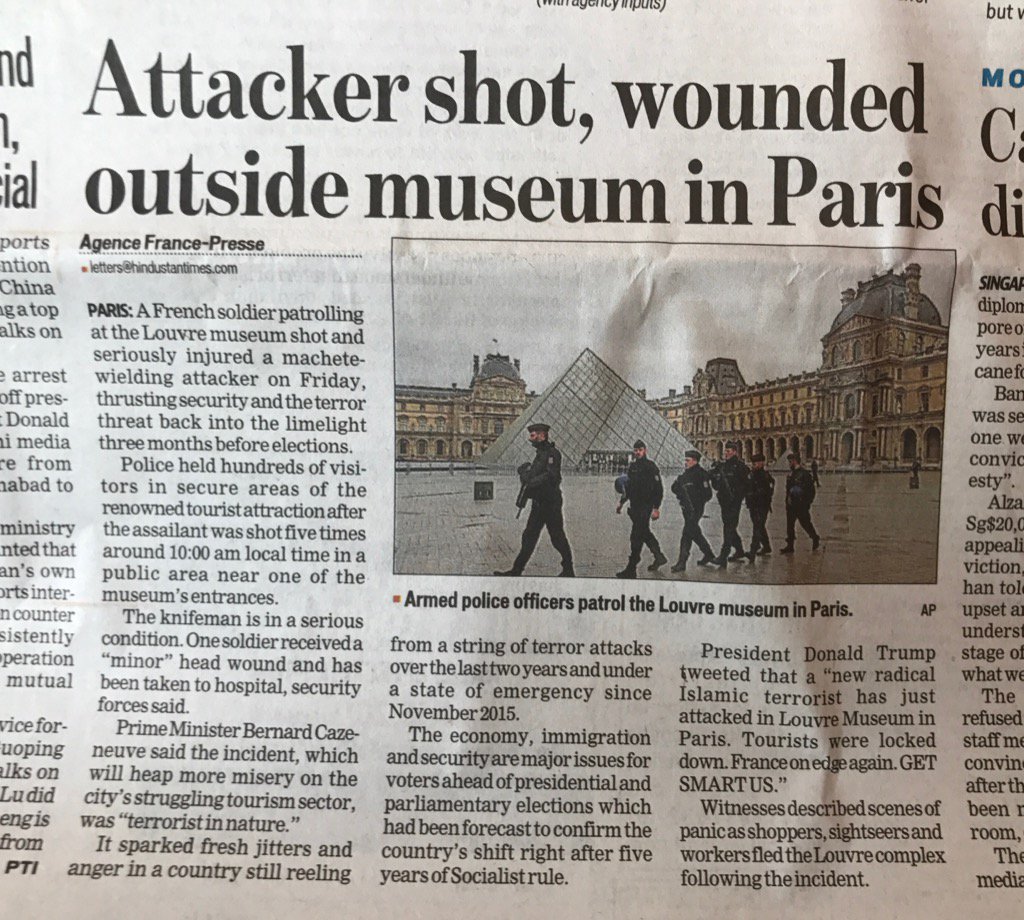
And it is even more inappropriate because Kashyap and his pseudo-secular companions in the entertainment industry, media and politics never use the term "Islamic terrorism" in their vocabulary. In fact, sometimes they go all out to even avoid using the term "terrorism" when they are perpetrated by Muslims. Below is an example of the sanitized coverage by Hindustan Times of the terrorist attack that happened at the Louvre museum in Paris two days ago.


Again, lest I be accused of Islamophobia, I must say that I have nothing against Muslims. Muslims are human beings like any other person on this world, and deserve to live without fear of any form of persecution. In fact, some of my best friends are Muslims, and not just any Muslim but Muslims from Pakistan, the purported archrival of India. Sure, I have come across a few fanatic Muslims in my life, but I have also known a few fundamentalist Hindus.

So what I am essentially against is the double standards used by the so called "intellectuals" of our society in describing different acts of violence. It saddens me when one of the prominent media personalities like Rajdeep Sardesai refuses to cover the recent Dhulagarh riots in West Bengal where Muslim mobs attacked and looted Hindu shops and houses and set them on fire. It pains me when the same "liberal and secular intellectuals" who speak for the 'right of speech' of people who shout slogans in favor of terrorists--like Afzal Guru, for instance--don't speak in support of authors such as Salman Rushdie, Taslima Nasreen and Tarek Fateh, and even actively oppose their participation at literary festivals.

To be continued...: I will share my thoughts on the issue of "artistic liberty" in my next post.